What Was Africa Called Before It Was Called Africa?
- 5 hours ago
- 4 min read
For centuries, the name Africa has been used to describe one of the world's largest and most historically significant continents.
But there is an important question that many people continue to ask:
What was Africa called before it became known as Africa?
The answer is more complex than many people realize.
Africa was never a single country or empire with one official name. Long before modern borders existed, the continent was home to thousands of communities, kingdoms, civilizations and cultures. Different people referred to different regions using different names.
The Africa we know today has a long history of names, identities and civilizations that existed long before European colonial boundaries.
Africa Was Not Originally One Political Nation
One of the biggest misunderstandings about African history is the belief that the entire continent once had one name used by all Africans.
That was not the case.
Ancient Africa was made up of powerful and independent societies. There were kingdoms, city-states, empires and communities spread across North, West, East, Central and Southern Africa.
People identified themselves through their kingdoms, ethnic communities, languages and geographical regions.
A person living in the Mali Empire did not necessarily identify with the same political identity as someone living in Ancient Egypt, Nubia or Great Zimbabwe.
This means that searching for one single "original name of Africa" can be historically misleading.
Instead, Africa has been known by several names throughout history.
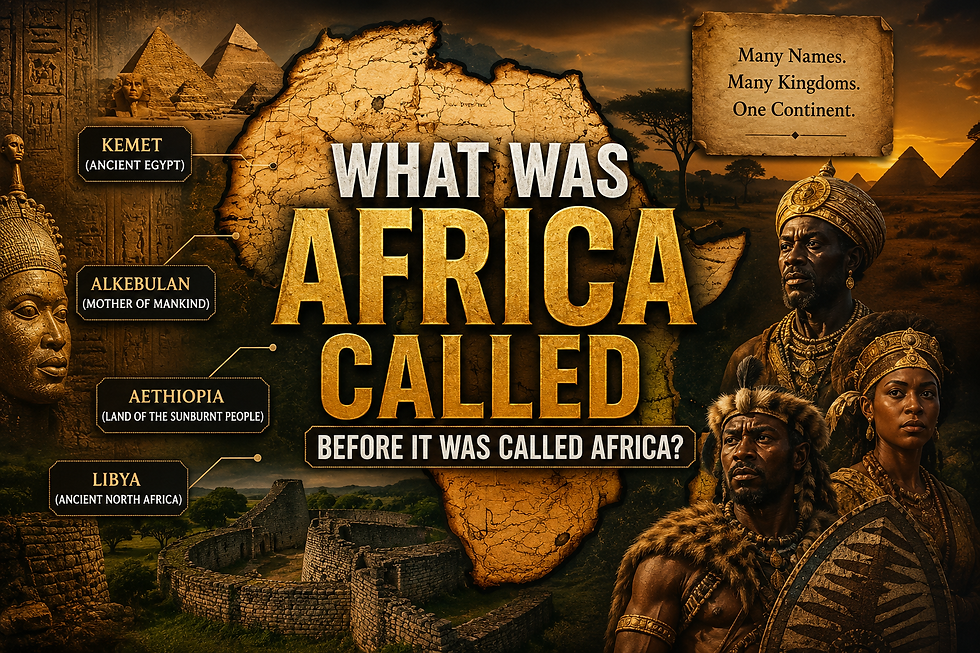
The Name Alkebulan
One name frequently mentioned in discussions about Africa's ancient identity is Alkebulan.
Alkebulan is often described in popular historical discussions as an ancient name associated with Africa.
Some interpretations have connected the name with meanings such as:
Mother of mankind
Land of humanity
Land of the Blacks
Garden of Eden
However, the historical origins and widespread use of the word remain debated among historians.
This is an important lesson when studying African history: not every popular story repeated online has the same level of historical evidence.
The history of Africa should be explored with curiosity, but also with careful research and verification.
Ancient Egypt and the Name Kemet
One of the most famous ancient names connected to African history is Kemet.
Ancient Egyptians used the word Kemet to describe their land.
Kemet is often translated as "the Black Land," referring to the fertile dark soil created by the Nile River.
This name distinguished the fertile lands around the Nile from the surrounding deserts.
Ancient Egypt was one of the world's greatest civilizations. Its contributions to architecture, mathematics, administration, medicine and writing continue to influence discussions about human history today.
However, Kemet referred specifically to Ancient Egypt, not the entire African continent.
Ethiopia and Aethiopia
Ancient writers also used the name Aethiopia to describe regions south of Egypt.
The meaning and geographical boundaries of Aethiopia changed depending on the historical period and the writer using the term.
In some ancient Greek and Roman writings, Aethiopia referred broadly to lands and peoples located south of Egypt.
This demonstrates another important fact about ancient geographical names:
Ancient names did not always describe the same political boundaries that modern names describe today.
Libya and Ancient North Africa
Ancient Greek writers sometimes used the name Libya for large parts of Africa west of Egypt.
The geographical meaning of Libya in ancient writings was much broader than the modern country called Libya.
This is another example of how historical geography changed over time.
A name that once referred to a large region could later become associated with a smaller territory.
Where Did the Name Africa Come From?
The exact origin of the name Africa has been debated for centuries.
One theory connects the name with people known as the Afri, who lived in parts of North Africa.
The Romans eventually used the name Africa for territories associated with their province in North Africa.
Over time, European geographical usage expanded the name until Africa became the name used for the entire continent.
The modern name therefore developed gradually through historical changes in geography, politics and language.
Africa Had Thousands of Names
Perhaps the most important thing to understand is that Africa's history cannot be reduced to one name.
Before colonial borders divided the continent, Africa contained powerful civilizations with their own identities.
There was:
Kemet in Ancient Egypt
Kush in the Nile Valley
Aksum in East Africa
Mali in West Africa
Songhai along the Niger River
Benin in present-day Nigeria
Great Zimbabwe in Southern Africa
Carthage in North Africa
Each civilization had its own history.
Each had its own people.
Each had its own language and cultural identity.
Colonialism Changed the Map of Africa
The modern map of Africa is relatively recent when compared with the continent's ancient history.
European colonial powers created and influenced many of the political borders that exist today.
Ancient kingdoms were divided.
Communities that had historical relationships were separated by international borders.
Traditional names were sometimes replaced with colonial names.
After independence, several African nations changed their names as part of rebuilding national identity.
Examples include:
Gold Coast becoming Ghana
Rhodesia becoming Zimbabwe
Upper Volta becoming Burkina Faso
Dahomey becoming Benin
These name changes demonstrate that names are more than geographical labels.
They represent identity, history, memory and political power.
Why Ancient African Names Matter Today
Understanding Africa's ancient names helps people understand something much bigger:
Africa has always had history.
Long before colonialism, the continent contained kingdoms, trade networks, universities, cities, political systems and civilizations.
Studying ancient African names allows us to look beyond modern borders.
It helps us ask deeper questions.
Who were the people who lived here?
What did they call themselves?
What kingdoms existed before modern countries?
How did ancient civilizations understand their land?
These questions are important because history shapes identity.
The Story of Africa Is Still Being Rediscovered
Africa's history is one of the richest and most complex stories in human civilization.
From the pyramids of Ancient Egypt to the libraries of Timbuktu, from the Kingdom of Benin to Great Zimbabwe, the continent has produced civilizations that deserve continued study.
The name Africa may be the name the world recognizes today.
But beneath that name are thousands of older identities, kingdoms, languages and civilizations.
And many of their stories are still waiting to be discovered.



Comments